What does the Facebook whistle blower have to say to parents?
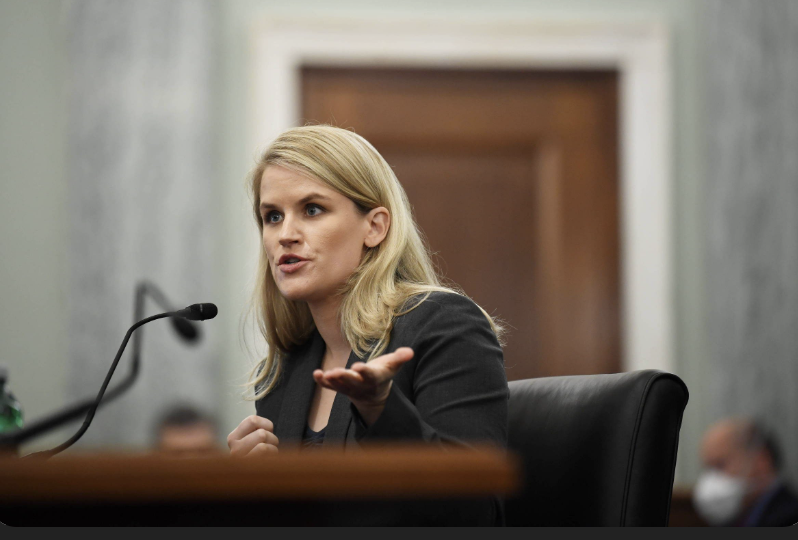
When we spoke the day Aaron Sorkin’s The Social Reckoning, the film inspired by her story, opened nationally, Frances Haugen shared with me that her current favorite photo of her toddler daughter was taken the night of the premiere. Haugen was dressed up and her 20-month-old had a great smile in the photo. Haugen’s mother loved it and asked if she could post it.
“Not without an emoji on her face,” Haugen taught her mother how to put an emoji over her daughter’s face. Once her daughter’s face was obscured, she green-lit the post.In 2021, Haugen walked out of Facebook with thousands of pages of internal research. When Haugen came forward, she says the world was shocked that Facebook had generated its own research about the ways its products were harmful to kids and kept it quiet. She pointed out that in the company’s early days, few if any FB leaders had children and almost none had kids old enough to use social media.
“So [they created] a product that is affecting how whole middle schools and high schools have been running for 10 years, and no one who makes that product has a kid in the relevant age range,” she said. “I think if parents realized that the early warning systems are just NOT in place, they would be a lot less willing to have their kids be the ones being experimented on.”
I think Haugen is being almost generous here. You don’t need your own middle schooler to understand how manipulative the like button could be—and if they were that young they should have remembered their own experiences of middle school. Even people with minimal empathy and curiosity had their own internal research to underscore how powerfully manipulative these features could be.
Of course, that lack of experience with parenting teens changed among the top brass at Meta over time. Another Meta whistle blower Arturo Béjar has described how his own 14-year-old daughter received inappropriate DMs from strange men, prompting him to escalate his concerns about the safety of the app.
If she had a teenager, would Haugen let them on Instagram?
Haugen is skeptical about younger teens on social media independently. To start out, she’d share an account with them or let them browse from her phone. Either way, she’d check in weekly to see what their feeds look like and talk through the “awkward situations” they’re likely to run into until they agree on what to do.
In her view, the worst experiences on social media happen when we mindlessly scroll. “The question is, do you leave your kid alone to be led wherever the algorithm goes,” she said, “or do you check in once a week or multiple times a week.”
Sitting together gives parents a chance to build media literacy: Why do you think they chose that angle? Why did they feature this and not that? Why do your friends post this kind of content? Kids need to understand that what they see doesn’t represent the world objectively. As she put it, “People don’t post their bad hair days.” It’s something I talk about with kids all the time: people post from the mountaintop, not from the fight with their family on the way up.
When I asked her how to respond when teens ask why their feed keeps serving up racist, violent, or body-shaming content they never went looking for, Haugen has a simple answer. Your feed is built by a computer program that doesn’t understand the meaning of what it shows you. “The only thing looking out for people is people,” she said. She would tell a child: “A lot of people… thought there was no way a computer program could hurt someone, and unfortunately, that meant they weren’t vigilant enough to make sure that you were safe.”
My perspective: it’s worse than that. The algorithm measures and optimizes for how much time you spend. If a video or image is malicious or exploitative but it keeps your eyeballs on the screen, then the algorithm is succeeding at its goal which is more minutes of app use. Saying that Facebook’s architects didn’t anticipate that people could experience harm while using an app lets them off the hook too much. They built systems that can reward harmful experiences because those outcomes are profitable. It wasn’t a mistake–it was designed into the apps.
Fear and greed are more motivating than moral compasses
Haugen believes that Meta didn’t roll out safety features because kids are getting hurt. They only changed when they faced consequences.
In 2021, Facebook answered her disclosures by pointing to its list of features for kids. What it didn’t say, Haugen noted, is that half of them had launched in a one- to two-day span that summer, when the UK’s Age Appropriate Design Code took effect. Meanwhile, the company’s own internal reports showed that over half the people reporting unwanted sexual messages were kids, and over half of those messages came from adults the kids didn’t know.
Advocates had been asking Instagram to make kids’ accounts private by default for years. Court documents showed the problem with the platform’s people recommenders: “If you are a 45-year-old who keeps looking for 14-year-olds, we will start recommending you 14-year-olds.” Then, in 2024, Meta rushed out a batch of safer defaults for teen accounts and even pre-announced some of them. “They were that desperate,” Haugen said. Why? Because they knew Australia was pursuing an under-16 social media ban, which they passed shortly after the new defaults in the app.
She contrasts that flurry of changes with 2021, when the Senate asked Facebook for its research on kids’ safety and well-being and got a non-response.
“Now we live in a world where they are afraid,” she said. “They are actively launching features that were asked for for 10 years, because they see that more and more places are not willing to wait anymore.”
I shared with Haugen that I was disappointed when Instagram copied Snapchat’s map feature in 2025. To me, this is a very problematic feature that gets kids far too accustomed to surveillance. She agreed the map can lead to FOMO and that the personal safety risks are huge.
“They don’t optimize for kids’ safety; they optimize for consequences,” she said. “It’s always two steps forward, one step back.”
Overall though, she believes Meta has launched more safety features in the last two years than in the five years before she came forward because of the increased legal and public scrutiny.
Sticking Up for Kids
When I asked what gives her hope, Haugen talked about her adventurous young daughter. She lets her mom toss her in the air and tumble around with her. “All kids should get to have not just a digital life,” Haugen said, “but an in-person life too.”
When we talked about the premiere photo of her toddler, Haugen says she is fine with her mother posting pictures of her. “I’m old enough to have participated in the decision,” she said. But her daughter isn’t.
I’ve shared with Haugen that I’ve been counseling parents on this for years. Many of the teens I interviewed for Growing Up in Public told me how devastated they were to find embarrassing images or videos their parents had posted. Some told stories of being teased by classmates over things parents had posted, with benign intentions.
Haugen agrees that adults need to check in with themselves. “I think it’s a power differential thing,” she said. “She doesn’t have much power, and I don’t want to abuse the power differential I have over her. I like her, and I hope she’s happy with me in the future.” As a longtime advocate of consent-based sharing in families, I love that Haugen’s mother checked with her, and Haugen advocated for her daughter.
Ultimately, Haugen believes the adults who hold power over kids lives owe kids far more consideration than they have been getting.
The Meta settlement adds new limits, like cutting off kids’ access late at night. When I pointed out that kids find workarounds, such as changing their phone’s time zone, Haugen agreed. “Kids are smart,” she said. That’s why, she argues, we have to keep pushing for social media actually designed for kids. “I’m not intrinsically prohibitionist. I just haven’t seen the platforms willing to do the work, to date, to design experiences that treat kids as first-class entities.”
The kids I’ve been talking with at schools all over the US would agree. They don’t want to be treated like dupes, manipulated, tracked or harassed. Perhaps the Meta Settlement and other lawsuits will push these powerful companies to a new level of reckoning.
Even as the companies are finally cowed into offering a somewhat safer user experience, we need to support and mentor our kids, focus on our own well being, and reduce our dependency on specific apps. No social app should feel mandatory. Kids need mentorship to wade into these spaces. As Haugen said, “You don’t have to hang out in places that don’t seem to show you respect.”
The only thing these companies fear more than government regulation and big legal settlements is attrition. If people walk away or dramatically reduce their time spent, the apps will become less central to community and connection. Like so many of their customers, not getting the likes and attention is their worst fear.